

 EN
 AR
 HR
 DA
 NL
 FI
 FR
 DE
 EL
 HI
 IT
 JA
 KO
 NO
 PL
 PT
 RO
 RU
 ES
 SV
 TL
 ID
 SR
 SL
 UK
 VI
 ET
 HU
 MT
 TH
 TR
 FA
 MS
 GA
 BE


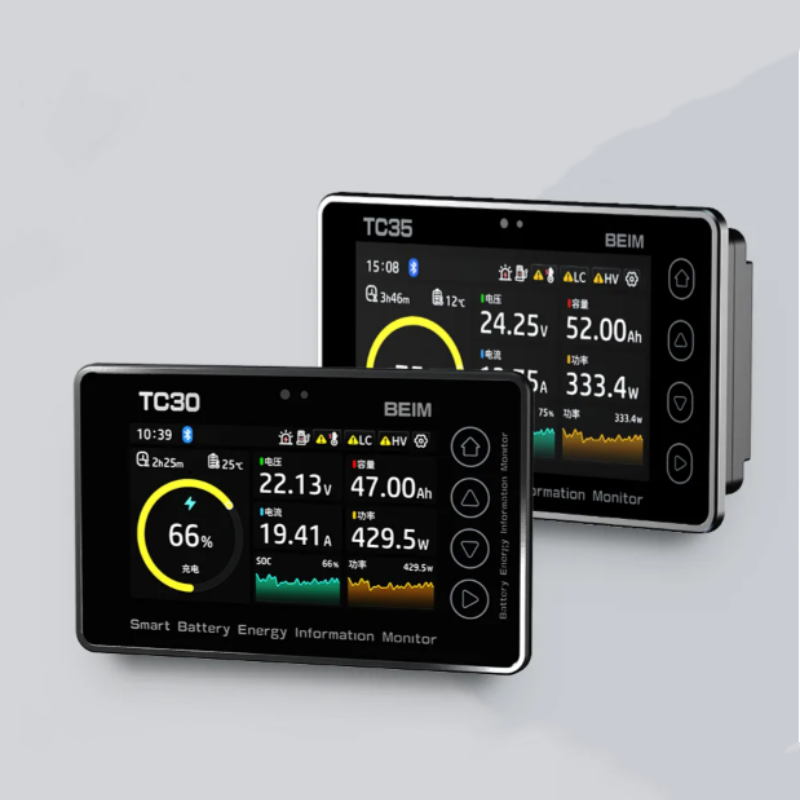
If you are specifying a battery display for an RV, an energy storage cabinet, or an industrial vehicle, the first decision is not the screen size. It is whether you need a voltage-type battery indicator or a current-type battery coulometer.
The two products can look similar on a panel. They answer different questions, and choosing the wrong type is one of the most common reasons buyers later say the SOC percentage looks wrong.
What a voltage-type indicator measures
A voltage-type battery indicator estimates state of charge mainly from the battery’s terminal voltage. Many models map voltage to a bar graph or a percentage, sometimes with an adjustable full/empty voltage range.
This approach is inexpensive and easy to install: it typically needs only a voltage sense connection, not a current sensor in the power path.
The limitation is built into the method. Battery voltage also moves with load, charging, temperature, and surface charge. A pack that is about half full can look low under a heavy inverter load and look full as soon as a charger is connected. For a rested lead-acid battery, the voltage-to-SOC relationship is often usable. For lithium iron phosphate (LiFePO4), the voltage curve is almost flat across a large part of the usable range, so a voltage-only display often stays near the same reading until the pack is close to empty or full.
What a battery coulometer measures
A battery coulometer (also called a current-type battery monitor or coulomb counter) measures charge going into and out of the battery. Current is typically sensed with a shunt, then integrated over time to calculate ampere-hours, remaining capacity, and usually a state-of-charge percentage. Most units also show live current, voltage, and often power or estimated time remaining.
Because it tracks energy throughput, a coulometer remains useful while the pack is under load or on charge—the conditions where a voltage reading is least reliable. It does need correct setup: system voltage and capacity should be configured, and the reading should be synchronized at a known full charge from time to time, otherwise drift accumulates.
What you can actually see
| Need | Voltage‑type indicator | Current‑type coulometer |
| Rough full / mid / empty on a simple lead‑acid pack | Usually sufficient | Also works; often more than needed |
| Remaining capacity while loads are running | Unreliable | Designed for this |
| Charge / discharge current and power | Typically no | Yes |
| Time remaining | Typically no | Often yes |
| LiFePO4 and other flat‑voltage chemistries | Easy to misread in the mid range | The more appropriate method |
| Installation | Usually simpler (voltage only) | Requires current sensing in the specified current path |
| Cost and panel complexity | Lower | Higher, but you get usable operating data |
Choose by chemistry and duty cycle, not only by price
Lead-acid and AGM still appear in many utility and backup systems. If the user only needs a glance at whether the pack is high or low, and the battery spends most of its time at rest, a voltage-type meter can be the practical choice.
LiFePO4 is now common in RV house batteries, home and industrial storage, and some industrial vehicles. Its flat voltage plateau is exactly where voltage-based SOC fails. If a buyer upgrades from lead-acid to lithium and keeps a voltage display, the percentage or bars may look stuck for hours, then change quickly near the ends.
Duty cycle matters as much as chemistry. Frequent cycling, high inverter loads, solar plus alternator or charger input, and any job where an operator must decide whether a route or a discharge cycle can be finished—these are coulometer applications.
How this maps to RV, ESS, and industrial vehicles
RV and caravans. House batteries often power inverters, lighting, and appliances while also accepting charge from solar and a vehicle alternator. The operator needs remaining capacity and current, not only a voltage snapshot. A coulometer is usually the right class of instrument. If the panel sits in a wet or bright area, check the display and enclosure accordingly, and confirm the working voltage covers the fully charged voltage of a 12 V or 24 V lithium pack, not only the nominal voltage.
Home and industrial energy storage. Cabinets and off-grid systems are frequently LiFePO4 and cycle daily. Integrators usually need current, remaining ampere-hours, and a stable SOC while the inverter or MPPT is working. A voltage-type indicator can still serve as a secondary voltage window, but it should not be the only SOC source.
Industrial vehicles (forklifts, sweepers, tour buses, and similar equipment). Operators and fleet staff need to know whether the pack can complete a shift. Loads are high and change quickly, so voltage sag is normal. Specify a coulometer whose current range covers peak load, not only average current, and whose voltage range covers the fully charged pack, including series configurations.
A practical specification checklist
Before comparing screens or housings, write down:
1. Battery chemistry — lead-acid, LFP, or another lithium type.
2. Maximum working voltage — include charge voltage, not just nominal voltage. For example, a “12 V” LFP pack is often charged to about 14.4–14.6 V.
3. Current range — inverter, motor, or charger peaks, with margin.
4. What the user must see — voltage only, or current, remaining Ah, and SOC under load.
5. Environment — cabin, outdoor, spray, dust, or night-time readability.
6. Interface — local display only, or Bluetooth, RS485, CAN, or other OEM requirements.
On Baiway’s product line, voltage-type meters (such as the VT and LY series) are built for voltage-based indication.Current-type coulometers (such as TC147, TR24, TF03K, and TC30) are built to display capacity and operating current as well as voltage. Always confirm the exact voltage and current range on the datasheet for the model you intend to order; ranges differ by SKU.
Mistakes that show up after installation
• Choosing a meter by nominal voltage only, then finding it cannot tolerate the charge voltage of a lithium pack.
• Using a voltage indicator as an SOC meter on LiFePO4 and treating a mid-range reading as precise.
• Sizing the current range to average load, then clipping during inverter or traction peaks.
• Skipping capacity setup and full-charge synchronization on a coulometer, then blaming the product for drift.
• Expecting any display, of either type, to replace a battery management system (BMS). A monitor reports status; it is not a protection device.
Next step
If you already know the chemistry, pack voltage, and peak current, send those three figures with the application (RV, storage, or vehicle). That is enough to tell whether a voltage-type indicator is sufficient or a current-type coulometer should be specified, and which range to quote.
