

 EN
 AR
 HR
 DA
 NL
 FI
 FR
 DE
 EL
 HI
 IT
 JA
 KO
 NO
 PL
 PT
 RO
 RU
 ES
 SV
 TL
 ID
 SR
 SL
 UK
 VI
 ET
 HU
 MT
 TH
 TR
 FA
 MS
 GA
 BE


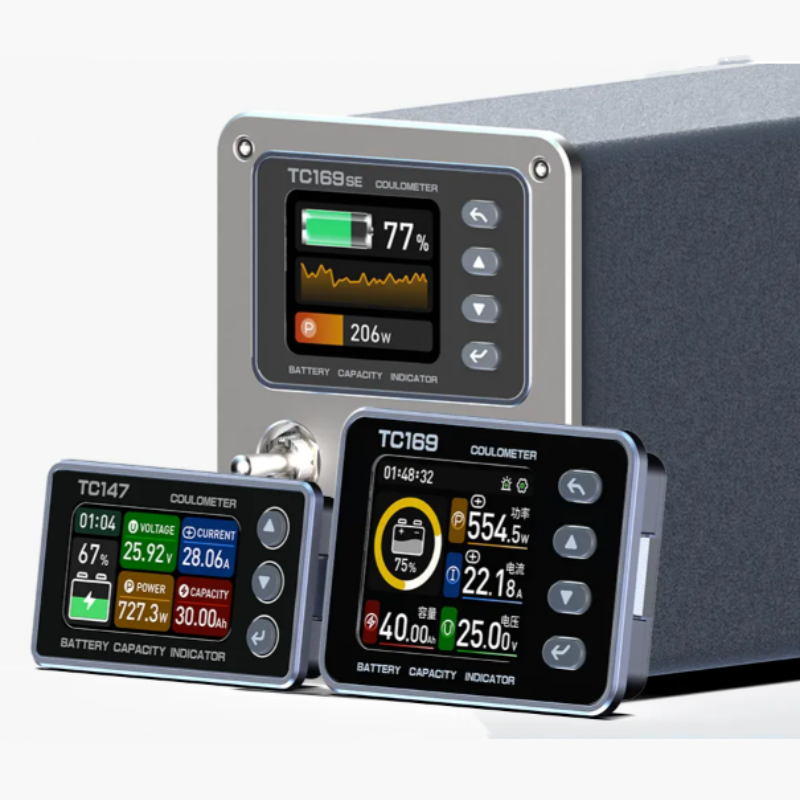
An RV house battery rarely sits at rest the way a standby pack does. It may run an inverter, take charge from solar at the same time as a vehicle alternator or a generator charger, and has often been converted from lead-acid to lithium iron phosphate (LiFePO4). The useful question is whether the instrument can report remaining capacity and operating current while those loads and chargers are working.
The first class decision—voltage-type indicator versus current-type coulometer—is covered separately. For most RV house batteries, especially lithium packs and inverter use, a coulometer is the more appropriate class. This article looks at the specifications and installation details that determine whether the reading is usable.
Start from the house-battery duty cycle
Inverter loads are uneven. A microwave, induction cooktop, or air conditioner can draw a large current for minutes, then drop back to lights and a fan. Pack voltage sags and recovers with the load, so a voltage-only display can look empty during cooking and recover a few minutes later, even though little capacity has been used. To judge whether the pack will last the night, you need remaining ampere-hours and live current, not a voltage snapshot.
Charging is often concurrent: an alternator, a solar MPPT, and a generator or shore charger may operate together while DC loads are still on. The monitor only accounts for energy that passes through its current sensor; if a source or load bypasses that sensor, remaining capacity will drift.
A lead-acid-to-lithium conversion also changes the voltage window. On a rested lead-acid battery, voltage is often a usable rough guide. After a swap to LiFePO4, the curve is almost flat across much of the usable range, so a voltage-only display can sit still for hours and then move quickly near the ends. A “12 V” LFP pack is often charged to about 14.4–14.6 V, and the meter’s working-voltage rating must cover that charge voltage, not only the nominal 12 V.
A battery monitor does not replace a battery management system (BMS). It reports status; protection remains the job of the BMS.
Specify maximum working voltage, including charge voltage
Write down the highest voltage the house pack will actually see: the charge voltage set by the charger or the BMS, not the nominal “12 V” or “24 V” on the battery. For a 12 V LiFePO4 pack, an industry-common charge window is about 14.4–14.6 V. For 24 V or 48 V banks, use the actual charge voltage of that system.
A meter that works at rest can still go out of range once a lithium charger reaches absorption voltage. Confirm that the working-voltage range of the model you choose covers that peak. Voltage windows differ by model and are summarized later in this article; they are not interchangeable. A 48 V bank, for example, will sit outside a meter that only covers 12 V and 24 V systems.
Size the current range to peaks, not to a quiet afternoon
The current range must cover the highest current the sensor will see, with margin—not the average of a quiet afternoon.
Estimate discharge by dividing the inverter’s continuous power by the lowest pack voltage you will actually use, then allow for efficiency and short surges. On a 12 V house bank, a 2000 W inverter is in the region of 180–200 A once efficiency is included, and can be higher at start-up; a 3000 W unit scales up from there. If the same sensor also sees charging, include the peak from the alternator, solar array, or generator charger that can occur at the same time.
If the range is sized only to average load, the reading clips during microwave start-up, an air-conditioner surge, or a hard alternator charge. Clipping also corrupts the ampere-hour count the coulometer is there to provide. Current ratings differ by model, so match the peak you calculated to the current range of the specific unit; examples are given below.
Display readability, protection, and where the panel sits
An RV panel may sit in a dim cabin, on a sunlit dash, near a wet entry, or in a dusty service space. Check sunlight legibility, whether the backlight can be dimmed at night, whether the housing suits spray or dust—and if not, whether the display can sit in a protected cabin—and whether the screen is where someone actually looks when deciding to run the inverter or leave a site.
Display features also differ by model. TR24 is a waterproof TFT color-screen coulometer, better suited to a wet or exposed mounting position; TC30 is a flagship HD color-screen coulometer. If sunlight or night dimming is critical, check the display in the actual mounting position. Voltage-type meters in the VT and LY series remain useful as a simple voltage window, but not as the only remaining-capacity reading on an LFP house battery under inverter load.
Installation: keep the shunt in the current path that matters
Most current-type monitors measure current with a shunt (also called a sampler) in the battery circuit. The rule is simple: the shunt must sit in the correct current path. Every charge source and load you want included in remaining capacity—inverter, DC loads, solar, vehicle alternator, generator or shore charger—should pass through it. If a charger lands on the battery side of the shunt, or a load is taken off before it, the coulometer will miss that current and the state-of-charge reading will drift.
After wiring, configure the system voltage and pack capacity, and synchronize the reading at a known full charge periodically. Drift after a skipped setup is a configuration issue. Mount the display where it can be read and treat the monitor as a reporting instrument: it does not replace the BMS, fusing, or correct cable sizing.
A practical RV specification checklist
| What to write down | Why it matters on an RV |
| Battery chemistry (lead‑acid, AGM, or LiFePO4) | Voltage‑to‑SOC behaviour changes after a lithium conversion; match the instrument class to the chemistry. |
| Maximum working voltage, including charge voltage | A "12 V" LFP pack is often charged to about 14.4–14.6 V; cover that peak, not only nominal voltage. |
| Peak discharge current (inverter or large DC loads, with margin) | Average current under‑sizes the range; clipped peaks also corrupt remaining‑capacity counts. |
| Peak charge current (solar, alternator, generator or shore charger) | Concurrent charging is common; the sensor must cover the highest charge current it will see. |
| What the user must see under load | Remaining Ah, live current, and SOC while the inverter is running, not only a voltage snapshot. |
| Display and environment | Sunlight, night dimming, spray or dust, and a position the operator can actually read. |
| Installation path | Place the shunt in the house‑battery path that includes the chargers and loads you care about. |
Choosing a current-type monitor for an RV
With those figures on paper, select a current-type coulometer whose voltage and current range cover the pack, and whose display and housing fit the mounting position.
In Baiway’s current-type line, the models we typically recommend for RV house batteries are TR24, TF03K, and TC30. TR24 is a waterproof color-screen coulometer with a working-voltage range of 8–100 V, and it is suitable for RV use; a 350 A version is available. TF03K is a 100 V / 350 A vehicle battery display for higher voltage or current windows; confirm the exact model when ordering. TC30 is the flagship color-screen coulometer.
TC147 and TC169 are more compact. TC147 has a working-voltage range of 8–80 V, TC169 has a range of 8–90 V, and both can be paired with a 200 A shunt (200 A continuous, 300 A peak), so they can still cover many 12 V, 24 V, and 48 V systems. Because of their smaller size, they are not our primary recommendation for RV use, but they remain a workable choice when a compact display is preferred and the voltage and current window fits.
When you are ready to order, confirm the exact voltage and current range for the model you need. VT and LY voltage-type indicators can still serve as a secondary voltage window, but not as the only state-of-charge source on an LFP house battery that runs an inverter.
What to send before you specify a unit
If you already know the chemistry, pack or charge voltage, and peak current—or inverter and charging power if current is not yet calculated—send those figures with the vehicle type (motorhome, travel trailer, or camper van). That is enough to check whether a current-type coulometer is the right class for an RV house battery, which voltage and current window to quote, and which Baiway current-type options are in range.
Table of Contents
- Start from the house-battery duty cycle
- Specify maximum working voltage, including charge voltage
- Size the current range to peaks, not to a quiet afternoon
- Display readability, protection, and where the panel sits
- Installation: keep the shunt in the current path that matters
- A practical RV specification checklist
- Choosing a current-type monitor for an RV
- What to send before you specify a unit
