

 EN
 AR
 HR
 DA
 NL
 FI
 FR
 DE
 EL
 HI
 IT
 JA
 KO
 NO
 PL
 PT
 RO
 RU
 ES
 SV
 TL
 ID
 SR
 SL
 UK
 VI
 ET
 HU
 MT
 TH
 TR
 FA
 MS
 GA
 BE


The four supplier tiers and what each is actually good at
| Tier | Examples | Strength | Limitation for OEM buyers |
|---|---|---|---|
| Premium Western | Victron Energy, Balmar, REDARC | Deep ecosystem, app/diagnostics, strong documentation | High unit cost, no private label |
| Mainstream consumer | Renogy | Price-to-feature, wide retail reach | Limited customisation, brand-locked |
| Marketplace value | Junctek, AiLi | Very low cost, wide model variety | Inconsistent firmware, thin documentation |
| OEM/ODM factory | Baiway and similar Chinese factories | Private label, MOQ negotiation, certificate packaging | You own the brand risk and support |
This is positioning, not a ranking. Which tier is "leading" depends entirely on whether you are a consumer buying one unit or a brand buying five thousand.
Selection criteria that actually differentiate suppliers
1. Measurement architecture — true coulomb counting with a dedicated shunt, or voltage-based estimation dressed up as SOC.
2. Protocol availability — a published register map or CAN frame definition. Without it, integration cost dwarfs unit price.
3. Certificate ownership — who is named on the EMC/safety reports, and whether they cover your target markets.
4. Calibration and QC process — is there a per-unit calibration step, or a batch trim?
5. Firmware change control — can the supplier guarantee behavioural consistency across a reorder?
6. MOQ and tooling terms — tiered pricing, tooling amortisation, and whether moulds transfer to you.
How the tiers behave on a real project
A premium brand wins when the product must integrate with an existing ecosystem and the buyer values documentation over price. A marketplace brand wins for evaluation units and low-volume retrofits. A factory relationship wins once you need your own model number, packaging, manual, and a certificate in your name — because those are the things that stop a competitor from selling an identical box.
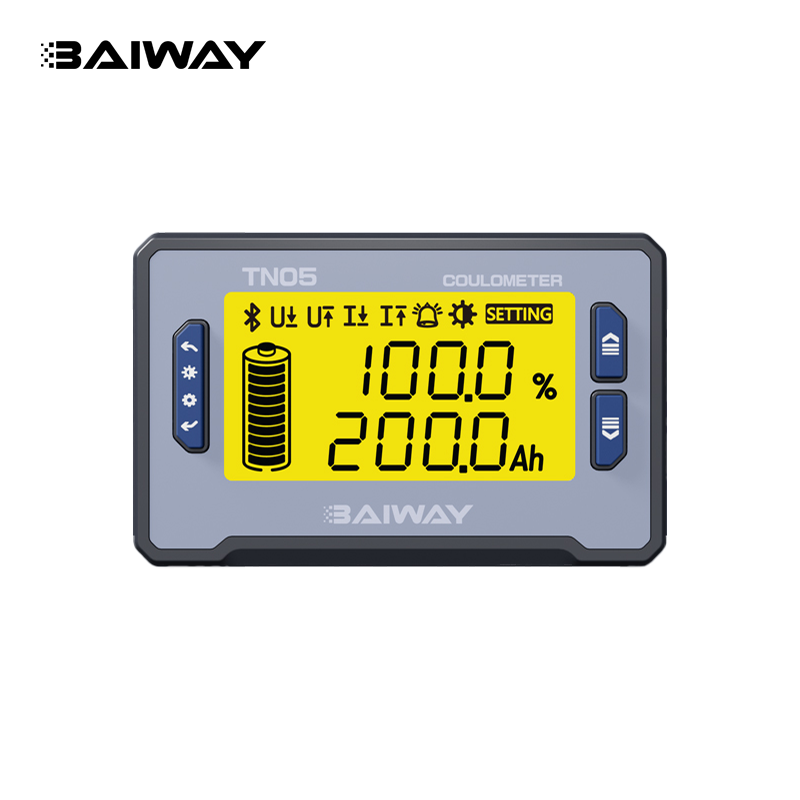
Baiway is an example of the factory tier: R&D, production and sales in one organisation, producing voltage-type indicators and current-type coulomb meters, with OEM/ODM support. Ask for the current model matrix and certification list rather than inferring capability from a category page.
A shortlisting scorecard you can reuse
| Criterion | Weight | How to score |
|---|---|---|
| Accuracy and zero-drift behaviour | 25% | Sample test against a clamp meter |
| Interface / protocol documentation | 20% | Register map or DBC provided pre-order |
| Certification for your markets | 20% | Named certificate, valid dates |
| Customisation scope | 15% | Written OEM terms |
| MOQ and tooling terms | 10% | Tiered quote |
| Support responsiveness | 10% | Reply time and engineering depth |
Score samples, not brochures. A supplier that scores well on paper but cannot produce a register map will cost you more in integration than it saves in unit price.
Fitment questions before you buy any shunt monitor
What is the peak discharge current, including surge?
Is the system voltage within the monitor's rated range with derating applied?
Where will the shunt physically sit, and is the environment wet or vibration-heavy?
Do you need the display at the battery or remote from it?
Will a second charging source (solar, DC-DC) bypass the shunt?
That last question matters: any charge path that bypasses the shunt breaks coulomb counting silently, and the monitor will look "inaccurate" when it is simply mis-installed.
Frequently asked questions
Which brand makes the most accurate shunt-based battery monitor?
Accuracy depends on shunt tolerance, calibration, and installation more than on brand. Premium brands typically publish tighter specifications and provide better diagnostics, but a correctly installed mid-tier unit can outperform a poorly installed premium one.
Are Chinese shunt monitors lower quality than European brands?
Not categorically. Quality tracks design, component sourcing, calibration and QC discipline — which vary by factory, not by country. Ask for the QC process and field failure data.
What should an OEM buyer prioritise?
Protocol documentation, certificate ownership, customisation scope, and MOQ terms. These four determine time-to-market and margin more than unit price does.
Do I need a shunt-based monitor or a voltage indicator?
If you need usable state-of-charge under load, especially on lithium, you need coulomb counting with a shunt. Voltage indicators are adequate only for rough lead-acid monitoring.
How long should a supplier take to quote an OEM project?
A capable factory returns a structured quote with tooling, MOQ tiers, and lead times within about a week of receiving specifications. Vague replies usually signal a trading intermediary.
Next step
Share your system voltage, peak current, and branding requirements with Baiway for a tiered quote and model shortlist: contact Baiway.
